
A salt room is a quiet, climate-controlled room built around salt, used for relaxation and breathing support. In an active room, the kind we have, a machine called a halogenerator fills the air with fine, dry salt. The benefits with the most support are thinner mucus, which can help a cough clear more easily, and a calm, quiet break. Research on asthma, COPD and sinus problems is promising and growing. Cleveland Clinic calls salt rooms generally safe for relatively healthy people.
Treat a session as an extra to your regular health care, Cleveland Clinic advises.
Each benefit below is sorted by how much research stands behind it. The sources are Cleveland Clinic, WebMD, Medical News Today, the American Lung Association and a peer-reviewed journal review. Our own salt room sessions in Fenton, Missouri, run 10, 20 or 30 minutes.
What Does a Salt Room Do?
Salt rooms work in one of two ways. In an active room, a machine called a halogenerator grinds salt into tiny, dry particles and releases them into the room. In a passive room, the room is filled with salt, such as Himalayan salt, and no machine moves it into the air.
Ours is an active room. It uses pharmaceutical-grade salt in a sealed room, and you breathe normally while the particles drift through the air.
A journal review from 2021 describes the controlled room used for halotherapy. It holds 64 to 75 degrees Fahrenheit (18 to 24 Celsius) and 40 to 60 percent humidity.
Dr. Norman Edelman, a scientific advisor to the American Lung Association, explains the main idea. When people breathe in fine salt particles, the particles land on the airway lining and draw water in. That thins mucus, so it is easier to cough up. He also notes that the air in these rooms is free of allergens.
The journal review adds that salt has antibacterial and anti-inflammatory properties and helps the airways move mucus out.

Salt Room Benefits by Level of Research
Not every benefit has the same support. Tap a level below to see what belongs in it, and what the sources say.
Thinner mucus
A calm, quiet break
Asthma, sinus problems and COPD
Skin conditions
Thinner mucus and an easier cough Most widely supported
Two doctors, one quoted by Cleveland Clinic and one by the American Lung Association, describe the same effect. Fine salt appears to thin mucus when you breathe it in, so a cough works better.
A calm, quiet break Most widely supported
Medical News Today says halotherapy can be relaxing and can improve your sense of well-being.
Asthma, sinus problems, bronchitis and COPD Promising, growing research
A review from 2022 and three trials from 2026 report better breathing scores and quality of life. The next section has the details.
Skin conditions such as eczema and acne Newest area
WebMD lists skin benefits, and Cleveland Clinic says more studies are needed.
Salt Room Benefits for Breathing
Breathing is where salt rooms have the most research, and the newer studies are encouraging.
- COPD, the big picture: A review from 2022 that covered 13 studies found a positive effect of halotherapy on people with chronic breathing conditions. Most studies showed better lung function scores and quality of life. The authors suggest it as a possible add-on to standard care.
- COPD, 2026 trials: A randomized trial of 208 people in nine centers tested a three-week course of cave therapy. People with COPD reported lighter symptoms. Cave therapy means time spent in a natural cave, the setting that halotherapy rooms imitate. In a placebo-controlled trial, 25 people with COPD inhaled dry salt without short-term side effects. A small study of 28 adults with asthma or COPD found better scores for breathlessness, quality of life and anxiety.
- COPD, in the lab: A 2022 animal study suggests halotherapy may quiet some of the inflammation pathways linked to COPD.
- Asthma: Literature reviews from 2021 and 2022 found early evidence that salt therapy may help clear mucus and support lung function. They also point to better quality of life. The 2026 cave therapy trial also reported better asthma control and quality of life. Researchers are asking for larger studies, and that is a good sign for the field.
- Sinuses, bronchitis and bronchiectasis: The journal review from 2021 reports trials with symptom relief. These covered sinusitis, bronchiectasis, chronic bronchitis, mild to moderate asthma and COPD. It calls salt therapy safe and well tolerated.
- Allergies: Healthline reports research in which patients with asthma or chronic bronchitis showed anti-allergic and anti-inflammatory responses.
The research points to salt therapy as a helpful add-on to regular care. If you have asthma, COPD or another lung condition, keep taking your medicines. Tell your doctor you plan to try it.
Salt Therapy for Skin and Mood: What We Know So Far
Salt air is said to leave skin feeling smoother and better hydrated. Skin is the newest area of research, and Cleveland Clinic says more studies are needed. If you try it for your skin, treat it as a bonus and keep following your dermatologist’s plan.
The calm is easier to count on. A dim room, soft sound and nothing to do but breathe give your nervous system a break. Cleveland Clinic’s Dr. Melissa Young says this kind of setting helps you reduce stress.
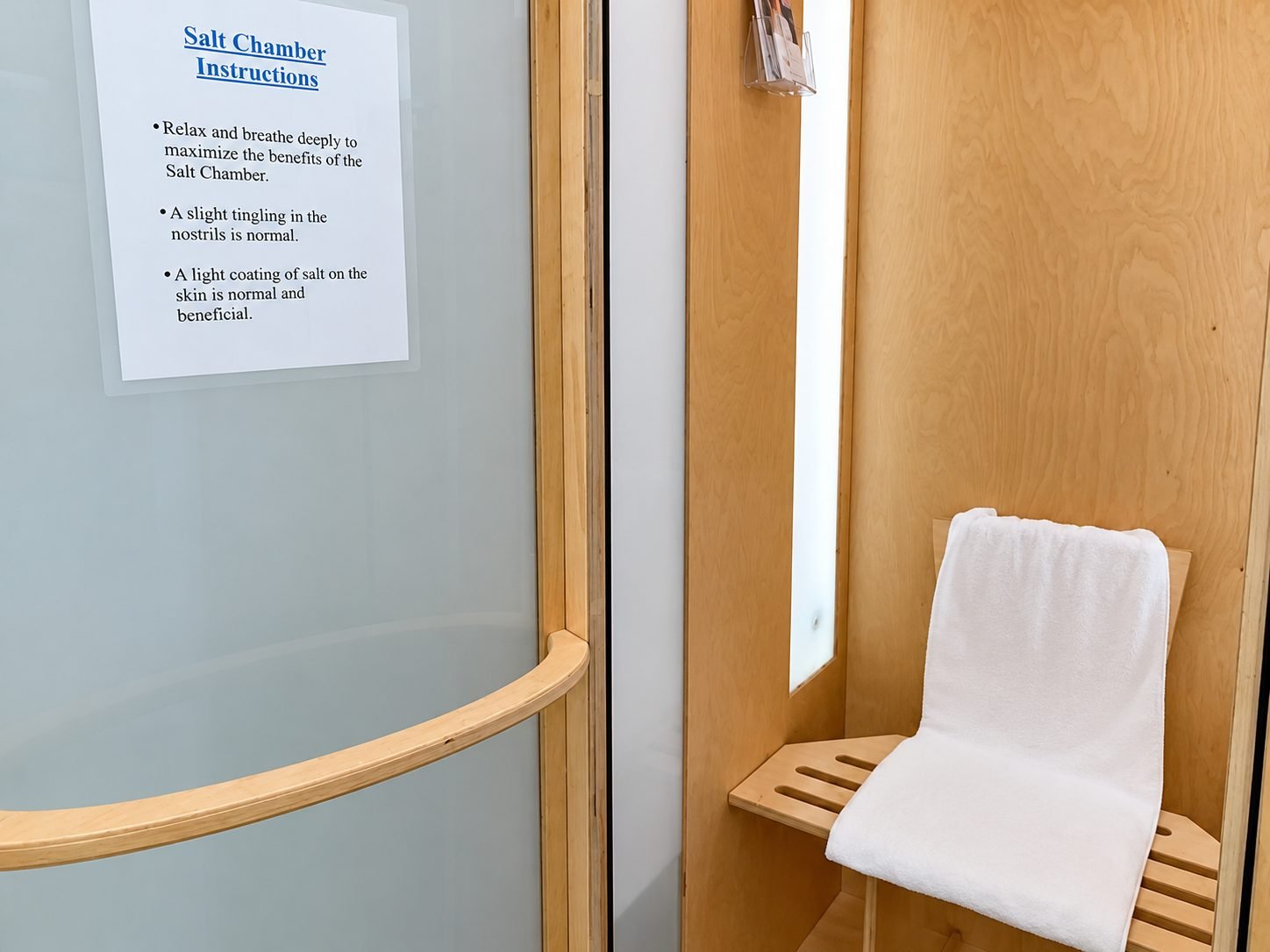
The guest instructions posted at our Fenton chamber say a light coating of salt on your skin is normal.
Salt Room, Salt Cave or Salt Sauna: What Is the Difference?
The words get mixed up online. Cleveland Clinic and WebMD both sort salt rooms into two kinds, and the difference decides what you actually breathe.
Active room
This is our room
Passive room or salt cave
No machine
Swipe sideways to see every column.
| Type | How it works | Good fit for |
|---|---|---|
| Active salt room | A machine, the halogenerator, grinds salt and circulates the particles in the air. | Breathing dry salt. Cleveland Clinic calls this the true halotherapy experience. |
| Passive salt room or cave | The room is filled with salt, such as Himalayan salt, with no machine. Less salt reaches the air. | A meditative, quiet setting, according to WebMD. |
| Salt sauna | A salt room with added heat. We do not offer one. | Warmth plus salt, if a sauna is what you want. |
| Wet salt therapy | Salt baths, gargles or nasal rinses. | Not the same as breathing dry salt, per WebMD. |
Three questions tell you which room you are in. Is a machine running? Is the salt in the air, or only on the walls? How long is the session, and why?
What to Expect in a Salt Room Session
At our Fenton chamber, a session is simple. You sit, breathe and let a timer run.
10 minutes
20 minutes
30 minutes
- Sit in the chair and relax. A towel is on the seat.
- Breathe normally. The posted instructions ask you to breathe deeply.
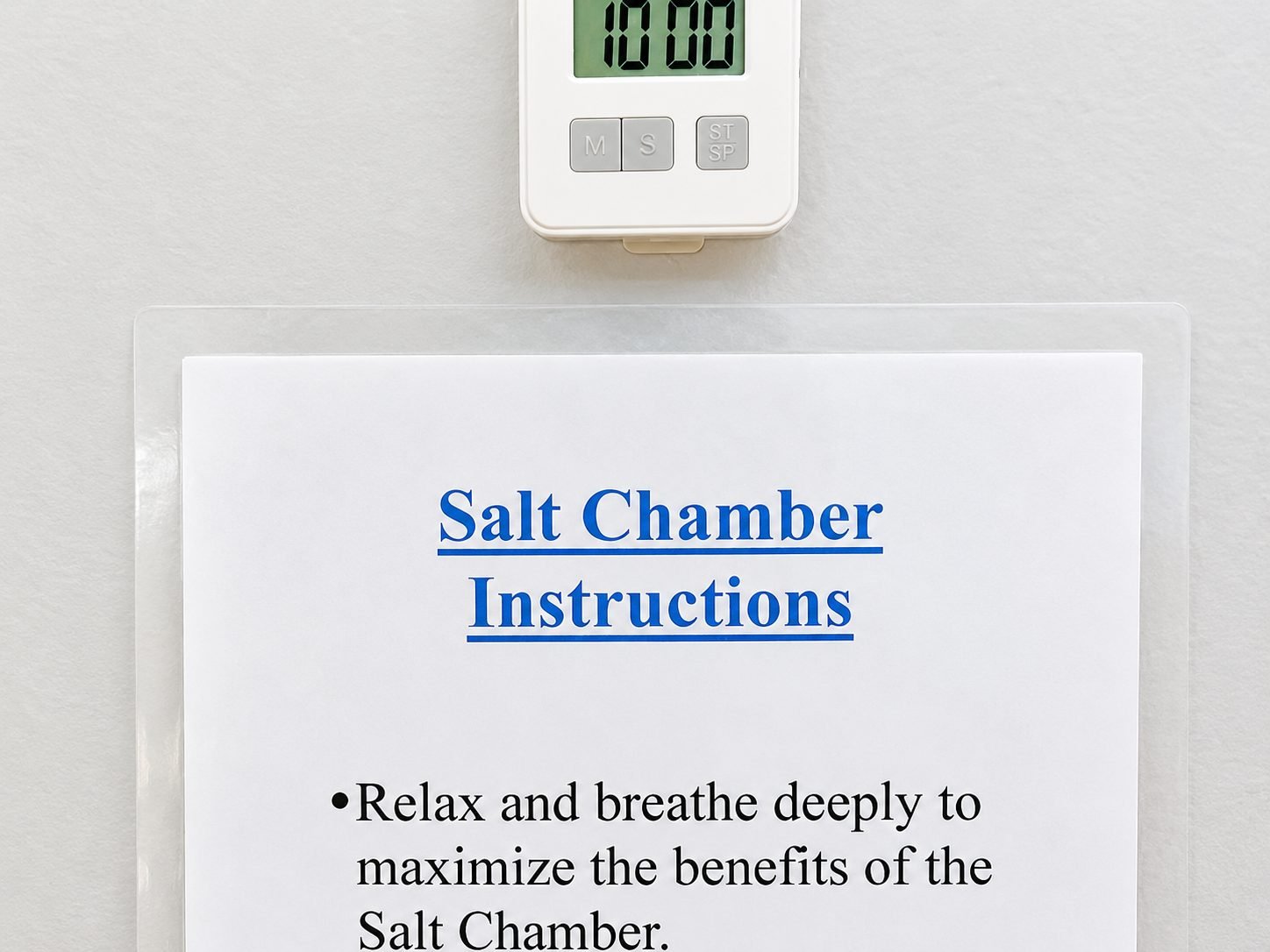
- Watch the wall timer. Your session runs 10, 20 or 30 minutes.
- When the timer ends, your session is over and you can go on with your day.
The instructions posted in our chamber also say a slight tingle in the nostrils is normal. There is no recovery time and nothing to prepare.
Questions to Ask Any Salt Room Before You Book
Cleveland Clinic’s Dr. Young says there are no defined halotherapy standards and that every room does it a little differently. The American Lung Association also asks how well rooms are kept clean. These questions help you compare.
Swipe sideways to see every column.
| Ask | Why it matters |
|---|---|
| Is a halogenerator running during my session? | It tells you whether the room is active or passive. |
| What salt does it use, and where does it come from? | Ask what grade of salt it is. The Fenton chamber uses pharmaceutical-grade salt. |
| How long is a session, and why that length? | Sessions range from 10 to 45 minutes. A short visit is an easy way to see how salt air suits you. |
| How often is the room cleaned? | The American Lung Association raised the question of room upkeep. |
| Who can I ask about my health condition? | Cleveland Clinic suggests a room where a medical professional oversees treatment. |
| Is the room large enough for me? | Some rooms are small, so ask if you dislike tight spaces. |
You are welcome to ask us any of these at the front desk.
Good to Know Before Your First Session
Most healthy people can relax in a salt room without trouble. Tap any line that fits you to see what the sources say, and check with your doctor first if it does.
Heart, blood pressure or thyroid Ask your doctor first
WebMD lists heart problems, high blood pressure and an overactive thyroid among the reasons to talk to your doctor before halotherapy.
A lung condition or asthma Ask your doctor first
Cleveland Clinic and Healthline both advise checking with your doctor first. The FAQ below covers asthma in more detail.
Fever, infection, a blood disorder or an open wound Ask your doctor first
WebMD names fever, infectious illness, blood disorders and open wounds, along with tuberculosis and respiratory failure.
Cancer treatment Ask your doctor first
WebMD lists cancer among the conditions where you should ask your doctor before trying halotherapy.
Pregnancy or another health condition Ask your doctor first
Cleveland Clinic advises talking to your doctor first if you are pregnant or have an existing health issue.
You dislike small spaces Ask about room size
Cleveland Clinic and WebMD both list claustrophobia, because some salt rooms are small. Ask to see the room first.
No guide can tell you whether a salt room suits your health. Your doctor can. Cleveland Clinic’s advice is to view salt therapy as an extra, not a replacement for any care you already get.
Book a Salt Room Session in Fenton
Our salt chamber at 50 Fenton Plaza offers 10, 20 and 30 minute sessions, with member pricing and monthly bundles.
To see session times and prices, call 1-636-492-2668 or use the booking button.
Salt Room Questions, Answered
These answers add points the sections above do not cover.
Cleveland Clinic says the salt may make you cough more for a while. That fits the idea that the salt thins mucus so your cough can move it out.
Medical News Today adds that salt can also irritate the airways and cause an acute cough. Call your doctor if you start wheezing or your chest feels tight.
The Salt Therapy Association is an industry group. It suggests one or two 10-minute sessions a week at first for most healthy people. Visits then space out.
One session is enough to see how it feels. If you come often, our monthly bundles cost less than single visits, and the prices are on our halotherapy page.
Ask your doctor first. Healthline notes that salt air may irritate the airways of some people with asthma, which can bring on coughing or wheezing. Some people also report headaches.
Tell our team about your asthma when you book. Leave the room if your breathing feels worse.
No. A lamp is a block of salt with a bulb inside. It does not put salt into the air you breathe.
Healthline says there is no evidence that lamps do more than add ambience.
Few studies cover children. Healthline says supporters call it safe for children, but little research backs that up.
Ask your child’s pediatrician before you book, especially for a baby or a child with breathing trouble.
In the 1800s, Polish physician Feliks Boczkowski saw that salt mine workers had fewer lung problems than other miners.
The American Lung Association adds a later story. A German named Karl Hermann Spannagel saw his patients improve after sheltering in salt caves during World War II bombing.
Sarah Hankammer owns our Fenton spa. Some guests pair a salt session with red light therapy in the same visit. You can learn what red light therapy for skin does in our other post. You can also compare at-home red light devices with professional sessions. See what services are offered in a spa for the full menu.
References
- Cleveland Clinic: What Is Salt Therapy?
- American Lung Association blog post on halo salt therapy
- WebMD: halotherapy overview, uses and risks
- Medical News Today: benefits, side effects and risks of halotherapy
- Healthline: halotherapy uses, benefits and risks
- PubMed: journal review of salt therapy for respiratory disease (Altern Ther Health Med, 2021)
Treat the guide as general information, not medical advice. For your own health, ask a licensed provider.